Tricky but Important Gluteus Medius Strength Exercise

Some videos NSFW possibly, due to explicit language or other reasons.

A fairly common issue with long distance hikers, runners and walkers is tightess and even pain down the outside of each leg, and it can be anywhere from the glutes down past the knee. There can be pain but not always. Sometimes a cause of this is said to be Iliotibial band syndrome, also known as IT Band syndrome. See Mayo Clinic – Knee Pain for details. I get some tightness along my left leg side when I walk on concrete for longer distances.

I don’t know if I have that particular syndrome because I am not a doctor, but it cannot hurt to do prehab type strength training on related muscles, namely the gluteus medius. Wiki – Iliotibial band syndrome is an basic information page on the issue. This issue is common in runners and is highlighted in several runner’s websites, here for example.

Dr. Jack Taunton at the University of British Columbia states in this article that “the days of only stretching and rolling are no more. Even a full-blown case of ITBS can be eliminated in just four weeks with an exercise regimen that focuses on strength, rather than flexibility.” Recommended is ‘Hip Abductor Strengthening’ and ‘Hip Gluteus Medius Strengthening’.

Several doctors write that they see a very high rate of success treating those two muscles. They also mention that core strengthening is important, and strengthening these muscles should be done as a preventative measure in all runners. I would assume that goes for cyclists who also experience this common issue.

A decent physical therapist and strength trainer, Jeff Cavalier of AthleanX strength program, has a great video about it. Apparently foam rollers and stretching don’t help but strengthening does work. Here’s a really good video focusing exclusively on the exercises, done by a runner. These require band(s). I’m going to make non-scientific bro statement about this video: “This guy knows his stuff!”

Another video, and here’s a good exercise in that, pressing against a wall with knee with weight on heel of other foot. Kristie Ennis does a good stretch here and I tried it: very nice. I can perform this fairly easily laying in bed without crossing the other leg.

Update: Exercise victory: all scheduled tasks complete!

I just wrapped up the final exercises, including Nordic curls. I’m going light on that. I may switch out the leg raise and use the Kristie Ennis exercise shown in the first link of the paragraph I mention her, above. I can get good intensity on the appropriate muscle that way. Also, I saw in one of the videos to do Bulgarian split squats with a weight only in the hand of the arm opposite to the foot being worked. That will force a compensation by the gluteus medius muscle. So I have some ideas to improve a couple exercises.

My success here is important since I am gaining motivation in several important areas of my life as a result. Volunteering can have the same effect and I recommend doing it where possible. Good friendships can be made and networking can occur.

I think I can see my traps come in which are the diagonal muscles visible from the front but reach up behind the neck. I’ve seen gymnasts with monster trapezoids. That’s a muscle that can be readily seen through a shirt, and many work it cause it’s a pretty many thing to have. I saw a gymnast mention that handstand pushups will cause it’s growth to explode. Now, I’m not quite at the strength level to try those yet: I keep rock solid straight arms to minimize the effort, which taxes me. However, I used to struggle a lot more. I feel *very* strong in the wall supported handstand and I can easily keep up for 40 seconds.

There are plenty of various progressions, and a big one is free standing handstand. I have trouble kicking up into it. I can get advice with a form check by putting a video in a forum somewhere. The internet is great that way. A place to do that would be like body-weight fitness on Reddit.

One of my long term goals is handstand pushups. Apparently, that is superb for multiple muscle groups including the shoulders and trapezoids. Very difficult, though. I have a lower body fat than many people at this time. It could change if I don’t regulate my food intake, but that’s an advantage I have at this time.

Nordic Curls: Hamstring Exercise for Strength and Injury Prevention

There’s considerable science behind the effectiveness of the Nordic curl for prevention of hamstring injury Soccer is a sport where it is common, but I assume any sport with sprinting and explosiveness occur on a regular basis. My hamstring has been injured in the past.

NIH-published study: The preventive effect of the Nordic hamstring exercise on hamstring injuries in amateur soccer players: a randomized controlled trial.

“The truth is you can build leg size by using only your body weight”.

I have no doubt weight can be added in the form of a backpack or weight vest.

Revisiting the L-Sit Progressions

Possible NSFW due to explicit language, other reasons.

The L-sit is a superb exercise for the triceps, latissimus dorsi, quadriceps, chest and shoulders. Barbend.com L-Sit Exercise Guide lists the following muscles worked:

  • Large muscles: Triceps, Latissimus Dorsi, Quadriceps, Pectoralis Major, Deltoids
  • Others: Rectus Abdominal, Obliques, Hip Flexors, Scapular Stabilizers, Forearms

It’s amazing how intensely the Latissimus Dorsi, Shoulders, Pectoralis Major and Triceps are worked simply holding the L-sit isometrically, and that is the reason I do them: these are the biggest muscles in the upper body. Largest.org – Largest Muscles in the body

Furthermore, the L-sit a compound movement. This type of movement is recommended to beginners for quick overall growth. On my primary compound movement day I do these along with the big one, the Bulgarian split squats, and the isometric, wall supported handstand.

Utilizing these just these three exercises consistently using progressive overload, I can put on noticeable size within a couple or three months. If I maintain within 5 pounds of current weight, my muscle definition will be very good since I am currently 140 lb at 5’10”, which is thinner than most people. I am optimistic: however, I am older and muscle growth is slower with older people.

Back to training advanced moves like the L-sit: In gymnastics, if a move or hold can’t be done yet, there are ways to improve the strength and coordination through one or more exercises called progressions. The following is one I found useful for myself as a non-gymnast.

Here’s a really strong gymnast and Youtube channel describing how to improve the L-sit:

Thanks to Ryan Hurst at gmb.io for a great description of the L-sit shown below.

I wrote the following to guide myself and maybe it’ll help you if you do this, but I’m a novice and the videos on this blog post have superb information.

Key tips

  • Always focus on raised shoulders-back and down. Strength is needed there. It will take time. This will guarantee that a floor L-sit will be possible.
  • Arms locked and arm pits forward.
  • Butt *below* shoulders in all the progressions.
  • Look forward straight.

Progression List

  1. Hold position with toes on the ground; get comfortable with it.
  2. Practice raising and holding a single leg at a time. Hold for 1 minute total time, then one minute without a break. (each leg). This works the arm strength and the strength of a part of the quadriceps not worked by the squat or any other conventional, popular exercise.
  3. Floating tuck L-sit: Leaning back. Goal is to hold for 1 minute continuously. At the start, try to get a good amount of total time with good form.
  4. Tuck L-sit and partially straighten legs a bit at a time. It will take awhile to do it.

Update on victory

Yay! Completed 3 sets on both legs of Bulgarian split squat and I did really tax those legs. There is slight knee pain that is diminishing fast just vertically below the knee cap in the front on the left leg.

This is a major accomplishment: it’s the first time I’ve done 3 sets on both legs. Tomorrow I’m going to be very sore. I need to work real hard on the handstand the same effort, and the L-sit, but I need rest. I feel good with the breathing.

Another update

The L-sit tuck is pretty tough. It’s amazing how much intensity hits the shoulders. They are so dynamic. A handstand really intensely hits the deltoids, and the hands are ‘above’ the head at the side, as close as possible to the head, but the L-sit has hands straight down at the sides and that still hits the deltoids really intensely. Obviously, the deltoids are very complex compared to antagonist muscle pairs like quads and hamstring or biceps and triceps.

I’m quickly racing towards full completion of exercises past due and due today. It’s good to give myself a little leeway with the rest day every three days. That will greatly aid in prevention of burnout by making goals easily achievable but still progressive.

Considering the abdomen bicycle movement, I have it listed at 45 reps, but I see that Athleanx recommends a 7 minute routine daily. That’s quite intense and it will help. What I do is keep expectations lower with with a 45 rep requirement, but I can do up to the 7 minute routine that Athleanx recommends if I feel good about it. I already did 10 more reps today because I was psyched how well it’s going. Still, it was broken up set, and ideally I can pull off 45 in a row.

I have never done a full set of Nordic curls and can’t wait to see how that pans out. It just takes consistency, simple. I have heard in videos that it does indeed contribute to hypertrophy of that muscle. Hypertrophy provides me three primary benefits:

  1. Looks: they will look much better, bigger, and well defined. This is a key factor in my strength training as I have committed to best represent the whole food-plant based diet which made massive, quick, and sustained benefits to my health. The diet is the Starch Solution by Dr. John Mcdougall.
  2. Injury prevention: Any muscle growth will aid in reduced chance of bone fracture. That is well shown in research that bone density increases with resistance training. I am performing resistance training on all major muscle groups simply with 3 body weight resistance exercises. All other exercises aid in high efficiency of the primary 3 exercises.
  3. Contribution to metabolism and other endocrine homeostasis: A decent amount of muscle is very good: NIH: Skeletal muscle: an endocrine organ

I write this to motivate myself and keep a log of my progress, but hopefully it will aid someone else, also.

Breathing During Strength Training: A Novice Perspective

Ever feel lightheaded consistently after a particular, intense strength exercise? I have, but never to the point of being wobbly on my feet. It might be that my breathing isn’t optimal and can be improved, which is what I’m doing.

After research which can be found in the last blog, and I am performing a modified method of holding breath through the entire rep and breathing only stationary at the top. While on the Bulgarian split squat, I am stationary at about 25-35 degrees at the top, and under tension. I start moving down while inhaling on the first second of the rep so it cheats a little with some breathing during movement, but this is no weight so far. Breathing with high weight reduces stability in the core, it is said. This reduction in stability can increase chance of injury in certain exercises, such as squats or other overhead weight exercises.

I no longer feel lightheaded! Also, I did 10 reps, the most so far. These reps are 8 seconds, so very, very slow. That includes 1 second at the top.

I have no doubt I am pushing myself at least near my maximum potential during overload: The muscle has little energy and walking is a chore after words. I’m no expert but from what little I have experienced, squats seem to be the most intense exercise.

I hope you feel invigorated after exercises and already use or will consider a breathing technique if you want to improve performance.

Over on calories but optimistic on training today

As I listen to the F-35s fly over for training at Luke Air Force Base near Phoenix, I’m gearing up to do my 3 strength exercises. Yesterday, I saw lots of good food at the homeless shelter where I serve, and afterwords treated myself to homemade whole wheat bread. It’s too easy to consume a lot of that bread, which is partly why I almost entirely eliminated it from my food program, replaced by whole wheat pasta and black beans. It might have been smarter to lessen the amount of bread and cook a can of black beans with it.

I will be cooking bread as a gift to the hotel staff in the next couple days, but if I go to a vegan Thanksgiving potluck dinner, I will make 2 large loaves of bread. The ingredients are:

  • Whole wheat flour
  • Yeast
  • Sugar
  • Salt

I will not eat bread with salt in it as I eliminated it from my diet. I think it causes a bit more hunger for me, and I tend to not measure it so it can get out of hand. The bread tastes a little flat without it but I need to add other spices like I do the whole wheat pasta and black beans.

I’m not hating on myself for overeating since it overeating with healthy food, and I don’t do it much. I think two things have increased my hunger recently: strength exercises, and stress. My sleep schedule is a little off and it is said that lack of sleep can increase calorie consumption.

Bulgarian Split Squats: Breathing

I don’t breath enough and I’m using a huge amount of oxygen when doing 7 second reps, now at 9 reps. I need to research this but how I research is key.

Update:

I know I need to find recognized and respected experts when searching for videos in any speciality. Using a scattershot method searching in Youtube and Google isn’t useful and can be harmful. I do know some of the video presenters, though. There are several Youtube channels I trust more for bodybuilding advice, trust at varying levels. For example, I have high respect for a champion level power-lifter when it comes to breathing during any strength exercise. I have a varying level of confidence of strength trainers across the web depending on which organization they serve, such as a major league baseball team, for example. There are a great deal of ‘trainers’ and ‘experts’ on the web who insinuate great knowledge but I can’t trust without a history of being a high level participant in the sport or a physical therapist.

Another method of determining good strength training form is to actually ask some of the power lifters. Although I won’t be doing power-lifting for maximums, I will still be doing progressive overload, plus they may know if there’s a difference in the way I should be breathing compared to what they do. Many power lifters have websites and are readily available to answer questions. Same goes for many fields of study and interest.

An example is a video I found OmarIsuf – HOW to Deadlift & Squat Correctly: Breathing, Abdominal Bracing & Total Tension (Ft. Cody Lefever). Cody Lefever has what I consider a decent competitive background in power-lifting. To me, this advice will therefore have decent credibility. However, the video pertains to lifting to what appears to be a single rep maximum and very high weight, not repeated lifts during a set of sub-maximal weight. I could contact this individual.

Here’s another lifter highlighted on OmarIsuf’s channel: Clarence Kennedy Squats More Than You. He’s a highly accomplished lifter who has squatted over 750 pounds. He’s doing something right and while he may or may not not utilize optimal form (without knowing more about him), I have at least some level of credibility in him since he was selected a Omar’s trainer. Omar seems to have a great deal of knowledge in lifting and frequently interviews researchers, scientists, and accomplished competitors in the field.

John Paul Catanzaro : This individual has some level of credentials, but the credibility or level of respect in the field is unknown to me. The related breathing article is Know When To Hold It: How To Breathe While Lifting. A reference to how some world class weightlifters breath during competition is helpful even if not proven to be ideal and may or may not be the safest method, but this mentions natural breathing can be fine with sub-maximal loads. The article mentions safety and not holding breath too long, and bearing down in the Wikipedia – Valsalva maneuver too long.

Other research (unauthenticated)

I found some information that I’m trying to accumulate and decide how to best breath, but the fact is I know I am lightheaded after I do my squats, and I know I’m not breathing enough using the diaphragm, which is mentioned in a couple technique videos. A couple links that seem useful (I’m no expert at this analysis, however):

Wikipedia – Valsalva maneuver : This entails inhaling while expanding the abdomen outward, which apparently forces the abdomen to do work and uses the diaphragm. Interestingly, very little is mentioned in the article related to strength training. This maneuver is mentioned by several individuals I listed above.

Update:

I exhaled and inhaled pretty quickly when I did 1 set of 10 reps on the right leg. 7 second rep and a quick breath of about 1/2 seconds at the top. When at the top, I’m still under tension, though. I wasn’t lightheaded at the end. It guarantees I breath a minimum amount. I’ll keep doing this but since I listen to a ticking clock to count seconds, I need breathing to be an increment of 1 second unless I cheat into the 7 second movement time. Anyways, I’m happy with this.

Apparently, an occasional problem lifting very heavy weight while performing that Valsalva maneuver is bloodshot eyes, headaches and vision disturbances. Those issues won’t be a problem for me for quite awhile. I’d say it will be at least a month until I progress far enough to actually possibly need a barbell for heavier weight. I can get a backpack to 90 pounds. I believe a typical weight room barbell is 90 pounds. Going into a weight room for the first time knowing I can easily pull off a 90 pound squat, and likely 100 pounds more since I can do 90 pound split squats, will be very nice indeed.

Squat Standards (lb) shows at my weight as a novice I should be able to lift 112 lb. I won’t get crazy but it would be nice to bump it up to the next category of Novice the first time in the gym. Optimistically, I could be halfway to the middle category of Intermediate, and there’s a shot at Intermediate the first time I go in there. However, I need training on safe form. I see plenty of guides that are legitimate, but critical advice on form is necessary to eliminate any unsafe habits early.

Static meal plan meets my nutrition requirements

In the past, I always gained weight after doing calorie counting to lose weight. I did it multiple times over the years, and I didn’t raise or drop weight fast, though, and it did help me, overall because I kept some of the weight off after some of the attempts. I found a good drop after quitting drinking seven years ago. There were many other benefits. However, what is the game changer for me is the whole food-plant based diet. If I don’t do calorie counting, I can get weight gain fairly fast, but it never comes remotely close to the weights I was hitting on the standard diet.

Of course, we all know it’s important no matter the diet to make sure nutritional requirements are met, especially if it’s going to be a fairly static food program. I have eaten basically the same meal now for at least a few months, twice daily, or three times. I checked it in cronometer.com, and I take a 500 micro-gram B12 tablet every couple weeks. Below is the general food, although I add blueberries, apples, bananas or some other fruit for a nice sugar taste. The taste is very satiating and full since I never eat the ultra-high processed, sugar snacks available. I don’t because it’s restricted from the food program: for example, anything with added sugar or oil is explicitly avoided.

It took me I’d say a total of a few months to get digestion adjusted to the new foods and very high fiber intake, but 80-90% of the adjustment took a few weeks. Cravings for fast food went away after a few months, I would say. I avoided media with food ads and avoided driving by fast food places where reasonable. Now, I have no response. Key is staying prepared with foods that are very easy to cook or already prepared. An emergency food for me is bananas. They are so cheap, but 3 can generally fill me up.

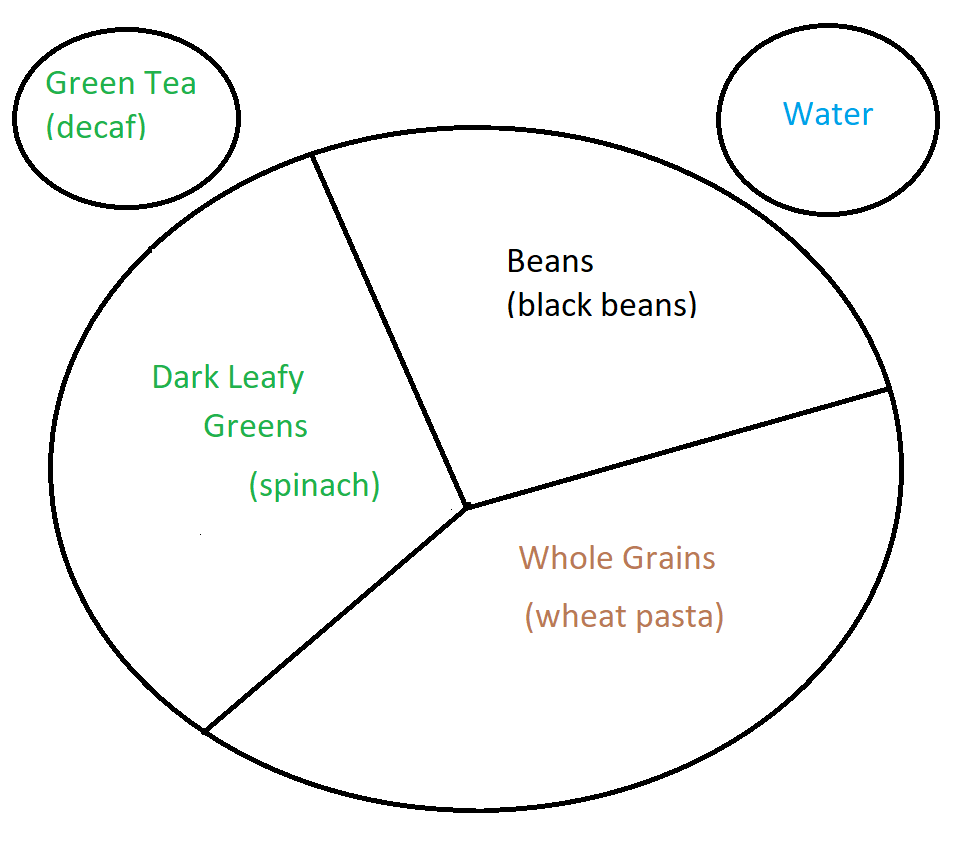
I am boring, eating the same meal everyday: the whole wheat pasta with black beans mixed with cayenne pepper and garlic powder. It satiates me. I don’t get bored but do require some varying fruits. They have a certain satiation level that’s shorter the main meal but still good, they don’t have to be cooked, and the calories are lower.

I do get in situations where I don’t eat. If I’m volunteering at a 4 hour shift and already haven’t eaten for 8 hours, well it’s a test, serving food. That only happens with poor planning, though. Of course, years past I would go to the drive thru or buy a pizza from the grocery and eat half of it. I’d cook meats like chicken thighs, boneless and skinless with some rice.

I’m wondering when I will get bored of this meal plan. It hits the spot!

Further refinement of workouts and schedule

Workout log (evolving the exercises and schedule)

I recently thought it’s not necessary to do some exercises as much and keeping total sets lower for the week where extra doesn’t have huge benefit will keep me from burning out or not meeting goals due to clutter on the schedule. This means I’ll do some things every six days instead: The rotator cuffs and super mans. If I add some other prehab exercises, they can probably go on the same schedule.

However, I think the prehab exercise called Nordic Curl should be added. It will benefit me some day because I will want to sprint at some point in the future, most likely. It’s only smart to do it when I have completed a few weeks or months of the Nordic curl. That’ll make me resistant to injury, along with the squats. There’s the possibility I get some hypertrophy on that muscle eventually, who knows. I’ll research it. Still, my primary focus is the Bulgarian split squats. I’ll put Nordic curls on the 6 day schedule and just do 1 set of reps to start. I believe I want to really strengthen them, so increase some part of it such as time, sets, rep duration, something like that.

Progressions

I gave some thought to progression, because that is necessary to continue with muscle building. I added the following progression types for the exercises. The handstand has been an isometric and it’s superb. Isometrics I can progress with adding time, and reps. Handstand pushups can be added.

The split squats I can add weight, but I have been increasing reps per set to get up to 10 reps of 7 seconds each. Weight can be in a backpack in any form: tools, food (cans of beans); water jugs.

L-sits for now is what is literally called progressions, but also time. That can have me move forward for months. I could use a backpack. My center of gravity will change. It will still put more weight on my triceps and shoulders. The predefined L-sit progressions go from tuck, to straight leg, to floor (instead of paralettes), V-sit, and then there’s more.

Maintaining Good Balance in Workout Schedule

I find that I can do accessory exercises 1 day, strength another, and rest the third and final day of the cycle. I’m also dropping the isometric at this point. Maybe some day in the future I can do that. I may add 1 more strength exercise to the 3 already done: something for the lats, like inverted row under a table.

I have the option of walking an hour any day, which is light and necessary for getting a good amount of sunshine for vitamin D and mood.

Concerning the accessories, they are good to support other activities and prevent injury, otherwise known as prehab. The gluteus medius exercises give some strength to help with tightness along the outside of the leg. I belong to the school of thought that strength training matters most for pain reduction, although stretching may help a little bit. My glutes are sore from yesterday, where I really pushed hard on the split squats and side laying leg raises.

The rotator cuff exercises will help there be less tightness in the shoulder blade area. I have no pain whatsoever. The right side gets tight and the muscle can be massaged and stretched easily, but prevention with prehab is best. The abdomen exercises really help all exercises, but help with injury prevention of the back. The supermans strengthen the lower back at least some basic level. They feel good, too.

The balancing on a leg with eyes closed exercise: this has the clear benefit of improving balance but also strength in the ankles and therefore bone density, also. I should challenge with more advanced techniques when I master this. I can also add the Nordic curl if I intend to do some running or sprinting exercises, or plyometric. They have been scientifically proven to significantly reduce injury chance in the hamstrings.

All leg exercises performed, especially the split squat, have great real life benefit for increased bone density, injury prevention, and muscle growth and definition. They will aid in difficult cardiovascular activities such as hiking. There are other benefits, such as significantly improving power on shots of a soccer ball.

Bodyweight resistance program challenges and outlook

I am a novice strength trainer trying to get in shape and documenting it as a sub-topic on my whole food-plant based motivational site. It is important to be a good example in homage to the program which turned around some health problems: the Starch Solution by Dr. John Mcdougall. Being thin, I look partly like what some perceive as a prototypical vegan. Changing that is attainable and I’m committed to making it happen.

I’m thin but I’m not eating to gain size. If it goes to the belly, which all of it does first (genetics), there is the risk of abdominal obesity, or central obesity. A person that is very low muscle mass and looks thin, but has enough belly fat to make it very unhealthy from a total mortality risk. Gaining weight with significant waist size increase is a ‘no’ for me since health is a priority. Mouth exercise won’t make me healthy at my current state, unfortunately. Only muscle building will work for me.

Keeping a thinner waist at nothing more than 32″ is the priority. There’s the BMI scale which is a general indicator of obesity but a better indicator is waist-to-hip ratio, and I won’t let mine get bigger than 0.9. I’m skinny all around with a 32.25″ waist, which is just under the cutoff for healthy value according to the link above. This is a strict value. Almost every American has a value substantially higher, as did I for many decades. I just happened on the whole food-plant based diet. It fixed a lot about me but uncovered another problem: lack of muscle.

The waist will drop as I progress on body weight strength program started in earnest this week, and I will eat to sustain my relatively light weight-until I reach a size of 29″. Then, I will run a slight calorie surplus until the waist hits 31-32″, and run at net zero until the waist hits 29″. I’m over 10 pounds from the minimum BMI healthy range, and won’t be dropping weight if I stick to this strength program. So running a waist from 29″-32″ for me in that range is 9 pounds total.

I don’t think I can drop the waist from 32″ to 29″ in a year maintaining weight and on a strength program. Although muscle building is highly variable, if I work out consistently on an moderate program for 1 year, at age 50 as a male it is expected I can gain 5 pounds of pure muscle doing strength training 2-3 hours per week. Here’s the muscle gain calculator I used: Scooby’s Muscle Gain Calculator. Losing 3 inches of waist typically requires a 9 pound drop in fat for me. I never dropped to 29 inches in my life so I don’t know the rate. It took a lot more weight to drop an inch when I was up in the 190 lb weight, but it came down to about 3 pounds per inch when in the 140 lb range and could be less during this process. No expectations at all, though. It could be a serious de-motivator to have waist size expectations during this process.

There are several disadvantages to this program which I am willing to accept to maintain closer to homeostasis through a fairly steady weight in my body. It is said that wild swings in weight are less sustainable, and I’m very close to settling in on a very healthy weight with an already very healthy diet.

Further, I have heard suggestions by science minded weightlifting coaches mentioning 1g/lb of protein is useful in this ‘recomposition’ phase. I do not wish to change my diet, and it is high enough at 0.75g/lb. Muscle building might be slower, yes. I accept it to stick on a very steady diet which has helped me in many ways, including lowering cholesterol, weight, blood pressure, heart rate and keeping all down for years.

Moderate time strength training: it won’t be hardcore. I will burn out, but it will be consistent 2-3 hours. However, the Scooby muscle estimator shows quite a bit less with the moderate program than hardcore: 5 lb in the first year versus 7.5 for hardcore. On the plus side, having no fat anywhere but the groin and belly will show any gains in a definitive way. Even AthleanX says that a person with lower body fat can look bigger than they are with relatively small muscle gain. I’ll never be a big bodybuilder unless I catch the bug and commit to hardcore workouts (and stay on it for a few years).

Challenges: Energy, and Consistency

It’s easy to churn over the science and methodology related to health and strength training. Getting in there and doing it is difficult. I need to remain consistent, but I need to increase my stamina to complete my routine in a tighter time frame, at least part of the workout. It is very difficult to perform the 6 sets of the L-sits, and Bulgarian Split Squats, intermixed with handstands for time The ancillary exercises are very easy, but I have to put in substantial breaks through the heavy hitters.

On a whim, I added a plyometric day. That’s very intense, and I may make it once a week to start. Plyometrics will quickly increase my stamina. I may keep my plyometrics quite short to start. I can’t set up another goal that may demotivate if failed.

Plyometrics benefits

  • Builds superb explosive leg strength and with that definition along with the squats I do.
  • It lowers resting heart rate, an indicator of overall health and cardiac fitness.
  • It substantially improves cardiac fitness.

Some inconsistent and fairly high heart rate cardio I do is hiking mountain trails around Phoenix.

Reasons for optimism muscle building on whole food-plant based diet:

  • Decreased time to recovery.
  • Far easier to prevent unwanted weight gain.

There is the distinct possibility I may progress faster than expected due to optimal nutrition. This is by no means a real science experiment, but I feel like I’m a lab rat doing this specific way on this specific diet, keeping a steady weight and doing recomposition. Now, I could go on a stricter weight program, but for now watching money and being able to do it in my current location without driving saves money on car expense and gym expense. Still, the coaching availability and motivation of like minded people may be of great benefit.

Rebuilding my Bodyweight Strength Routine-Close to Complete

I used to have a routine and it’s saved on some backup disk but I don’t have the equipment since I discarded a lot of my personal possessions, which I’m pleased about but that means I need a new set of exercises.

The primary exercises are Bulgarian Split Squats, wall support handstands, and L-sits. The rest are accessories to build up the abs, glute medius and rotator cuffs. I may add the Nordic curl, which is an exercise scientifically proven to reduce injury potential of the hamstring. It strengthens it through the whole range of motion, including eccentrically.

If I do those three primary exercises to failure every three days, I’ll be building good muscle for sure, but I need to increase my times steadily to ensure it. It’s somewhat risky to do a handstand to failure, but a wise man once said, if you want to do cool stuff you have to get a little dangerous. I’ll have to have consistency. I can get through some of the accessories pretty quickly.

I’m 1/3 of the way through my routine today. I’m eager to find out in the weeks to come how well a strengthened gluteus medius eliminates the tightness and funny business down in my knees. I get just a little pain occasionally and I think it’s related. Not much at all. It comes after walking on sidewalks for a few miles for a few days.

I also wonder the same about rotator cuff strengthening exercises and shoulder tightness, which isn’t pain. It’s muscle tightness I can loosen with a massage on that area. Overall, very excited but I have to be sure to maintain a relatively small set of exercises so this doesn’t get out of hand. I’ll build a plyometric exercise list and complete those every three days, also. Not enough rest days can lead to burnout.

Design a site like this with WordPress.com
Get started